
Go Back
Industry News and Updates

What We Learned at the IABFLO 2026 Conference And What It Means for Your Submissions
We just got back from the International Association of Bedding and Furniture Labeling Officials (IABFLO) 2026 Conference, and we have to say — it was a good one. These events are always a valuable opportunity to sit down face-to-face with state officials and industry colleagues, catch up on what's happening across the country, and bring back information that's useful for our clients.
This year, we had some particularly helpful conversations with the Pennsylvania team, and we wanted to share what we heard while it's fresh. Some of it is a reminder of things you may already know. Some of it is worth a closer look. Either way, it applies directly to how your Pennsylvania submissions move through the system.
Pennsylvania Is Paying Attention to Submission Quality
The Pennsylvania team was clear on one thing: incomplete submissions are the number one reason applications get delayed or rejected. It's not a new issue, but it keeps coming up and that tells us it's still tripping people up.
Here's what they emphasized and what we're passing along to you.
Online vs. Paper: The Processing Gap Is Real
If you have the option to submit online, take it. The difference in turnaround time is significant.
Online submissions are processed within 72 business hours, with notification sent immediately upon receipt.
Paper submissions can take up to 30 business days total — up to 5 business days just to confirm they received it, then up to 25 more to finish processing.
That gap can matter a lot depending on where you are in a product launch or compliance timeline. If you're not sure which route makes sense for your situation, just ask us.
Have Your Documentation Ready Before You Submit
The Pennsylvania officials we spoke with were straightforward about this: missing documentation is the most common reason applications stall. Getting something in the door before it's complete just creates more back-and-forth.
Before any Pennsylvania submission, make sure you have all of the following in hand:
- Authorization for Agent Representation (AAR) — must be current
- Active issuing license — your license needs to be in good standing at the time of submission
- Any outstanding back fees — unpaid fees will stop a submission from moving forward
If you're submitting on behalf of another company — which is something many of our managed-services clients do — Pennsylvania also requires the online application number to be included.
A Quick Note on Lab Reports
This one came up directly at the conference, so we want to be clear: a toy certification cannot be submitted in place of a lab report. They're separate documents, and Pennsylvania treats them that way. If you're not sure which one applies to your product, reach out before you submit. A quick conversation upfront saves a lot of headache after a rejection.
If you've been sorting through Pennsylvania's stuffed toy requirements more broadly, our post on Pennsylvania's new covering testing requirements is a helpful companion read. The documentation expectations are related, and knowing both helps you avoid gaps.
Pennsylvania Variance Petitions: More Than a Form, More Than a Fee
One of the other topics that came up at IABFLO is the Pennsylvania variance petition process. We've written about the basics of PA variances before, but we want to take a moment here to talk about what's actually involved, because it's more substantial than many people realize.
What Is a Variance Petition And Why Does It Matter?
Pennsylvania keeps a specific list of terms that are approved to appear on law labels. That list lives in §47.1 of the Bedding and Upholstery Regulations and §47.311 of the Stuffed Toy Regulations. If a term your product uses — because another state requires it — isn't on Pennsylvania's approved list, it's technically non-compliant under Pennsylvania law, even if it's perfectly correct everywhere else.
This is a real issue for companies selling in multiple states. States like California, Connecticut, Ohio, Oklahoma, and Utah require supplemental filling descriptions that Pennsylvania doesn't automatically recognize. Think terms like shredded, resinated, batting, gel, beads, or pad. If any of those appear on your law label without an active Pennsylvania variance, you're at risk of a license application rejection or a marketplace violation.
A variance petition is how Pennsylvania officially grants permission for your specific terminology to be used on your law labels. Once approved by the Pennsylvania Industrial Board, that language is covered — but getting there takes some coordination.
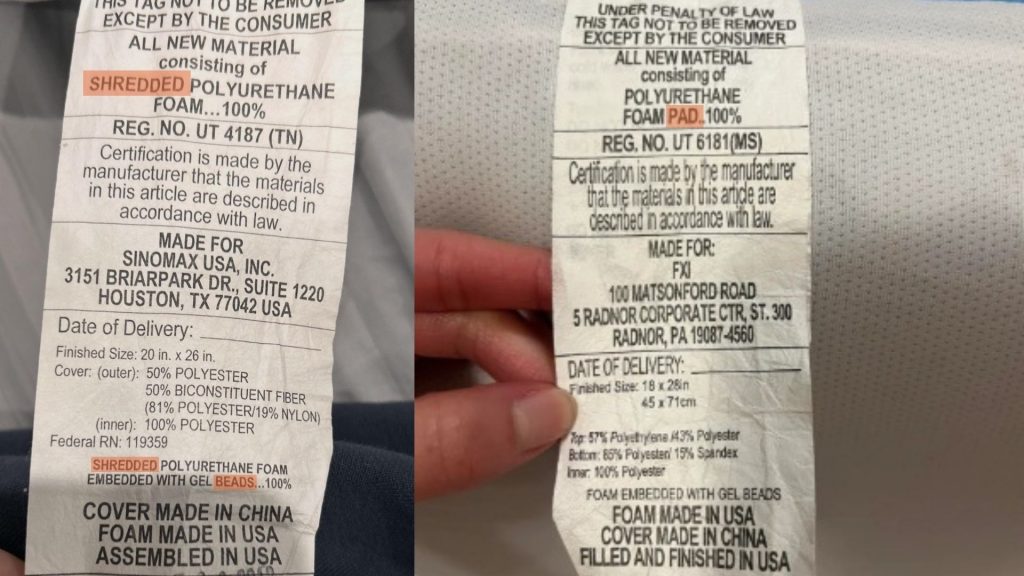
SEO alt title for image: Two law labels side by side showing highlighted variance terms — shredded, beads, and pad — on bedding products requiring Pennsylvania variance petitions for law label compliance
The Process Behind the Petition
The Pennsylvania Industrial Board meets once a month, on a schedule that's set in December for the following year. That means variance petitions have to be reviewed by the Department of Labor & Industry's Bedding & Upholstery and Stuffed Toys Licensing Team in sync with that monthly schedule. If you miss a submission window, you're waiting another full month.
There's a surprising amount of work involved in a petition:
- identifying which terms require a variance
- gathering the right documentation
- preparing a petition that holds up under the department's review
- tracking it through the board's cycle.
This isn't a form you fill out once and forget about.
What Our Team Does to Manage Your Variance
Our New Registration team now handles the Pennsylvania variance petition process.
Here is a summary of what our team works through for each variance:
- We stay current on Pennsylvania's approved terms list and when something is unclear, we reach out to state officials directly for clarification.
- Our team identifies variance needs during times such as the registration process, when testing reveals a filling type that requires one, on labels clients send, or when clients come to us already knowing they need one.
- After identifying which terms require a variance, we send an invoice for the associated costs if they weren't already included in the original registration quote. After payment is received, we draft the variance application, capturing all of the terms the client needs covered.
- We work with the client to obtain a label that includes those terms — or our team designs one — and we pull a copy of their Pennsylvania license for the URN the variance is being applied to.
- With payment and documents in hand, we submit the petition through Pennsylvania's online portal and handle any corrections that come up during processing.
- Variance approvals typically arrive seven to ten days after the board meets, and we review them carefully to confirm every requested term has been accounted for. The approval letter is then sent to the client for their records.
A variance petition is a managed, time-sensitive process with multiple steps, deadlines, and real consequences if something falls through the cracks.
If your products are sold in Pennsylvania and use filling terminology that might not be on the state's approved list, or if you're expanding into Pennsylvania and haven't checked your law label language yet, this is a good time to look into it. Get in touch with our team and we can help you figure out if a variance applies to you.
Staying Ahead of Compliance: The Bigger Picture
The conversations at IABFLO 2026 were a useful reminder that compliance tends to go smoothly when it's treated as an ongoing process rather than something you deal with when a problem shows up. Whether it's having your documents ready before you submit, choosing online over paper when you can, or getting a variance petition in place before your products are on Pennsylvania shelves, the groundwork you lay early makes a real difference.
A couple of other resources that may be worth your time: if you're currently handling your own importer license and submissions, our post on why self-managing your importer license may not be the time-saver it seems is worth a read.
And if you're working across multiple states and want a clearer picture of what's required where, our full range of compliance services covers everything from URN registration to ongoing monitored services that keep your renewals, reporting, and licensing from falling through the cracks.
If Pennsylvania has flagged your account for back fees, missing documentation, or a license issue, please don't wait on it. Those things have a way of compounding and blocking future submissions until they're cleared up.
Retail Compliance for Stuffed Articles: Protect Your Holiday Sales From Supplier License Lapses
How Stuffed Article Compliance Really Works: Inside the Product Regulation Process
Want the latest articles and events delivered to your inbox?

Navigate
Services
Services
Stay in Touch
Sign up for Updates