
Go Back
Industry News and Updates

Your Year-End Stuffed Article Compliance Checklist: 10 Steps Before 2027
With how busy and fast December gets, it is highly suggested to do a compliance audit before the calendar reaches the new year. Between holiday orders, year-end inventory, and planning for next season, compliance can very easily slide to the bottom of the to-do list.
That's why we recommend a quick end-of-year compliance audit: a self-check you run on your own GRS account in November. And it doesn't need to take long. Log in to your GRS account, work through the 10 items below, and flag anything that looks off. If you find an issue, our team is here to help you resolve it before it turns into a late fee, a rejected renewal, or a violation in 2027.
1. Check for unpaid invoices
Start with the easiest win. Look for any outstanding invoices in your account and pay anything still open. Unpaid invoices can hold up renewal work and lead to late fees, and agency late fees can add up quickly on top of that.

2. Confirm license status and upcoming renewals
Review every license in your account and ask two questions. Is each license in good standing in every state where your products are sold? And are any renewals coming up in the next few months?
Keep in mind that bedding, upholstered furniture, and quilted clothing licenses stay active until they're formally closed, even after a product is discontinued. If your products might still be on a retailer's shelf, the license needs to stay current.
3. Clear outstanding sales reporting
Detroit, North Carolina, Ohio, Oklahoma, and Pennsylvania all require sales reporting, and renewal work can't move forward until those requests are complete. Check your account for open requests and finish them.
One common snag: after you complete each state, you still need to click “Confirm” at the bottom of the recap page to submit. Our guide to sales reporting in the GRS Portal walks through every step. To make next year even easier, the Annual Sales Reporting Workbook helps you track sales as you go, so you're ready when requests arrive.
4. Complete pending forms and missing AARs
Look for forms waiting on your action, especially missing AARs (Authorization for Agent Representation). Without a signed AAR, we can't act on your behalf with the state. Other forms to watch for include the North Carolina renewal form from the February renewal season and Pennsylvania Zero Sales forms.

5. Verify your account information

People change roles, offices move, and email addresses change. Make sure your contacts, mailing address, and billing details are current. Most importantly, confirm that compliance reminders are going to someone who will actually see them and act on them.
6. Double-check license names in Ohio and California
Name mismatches are one of the most common reasons these two states reject licenses. California requires an exact match between your license and your law label, meaning the name on your license must be stated exactly the same way on the label, including suffixes like "Inc." or "LLC." Ohio requires an exact match to your registered name, down to spelling, spacing, and punctuation.
Want a second set of eyes? A law label audit can catch issues before a state does.
7. Review your importer license management
Detroit renewal season is here. If you hold an importer license and GRS isn't managing the URN issuing license connected to it, we can't move forward with your renewal.
The fix is simple: email a copy of your issuing license to LM@globalrsinc.com. Our team will also be reaching out to request these.
8. Wrap up unfinished registration jobs
If you have registrations in progress, check whether our team has requested any forms or documents from you. Then look ahead. Are you launching new products, adding a supplier, or selling in new states in 2027? Starting registrations early keeps launches on schedule.
Not sure which registration you need? We wrote this for you: Stuffed Article Registration Types: Manufacturer, Importer, or Joint.

9. Prepare for violations
Violations depend on whether a product is still being sold and whether its license is active, not on when production stopped. Retailers can hold discontinued inventory for months or even years. In North Carolina, unresolved violations can bring civil penalties of up to $2,500 each.
Review your discontinued products and keep their licenses active if inventory may still be out there. Customers on License Management or Guaranteed Compliance have violation resolution included.
10. Review toy testing and Pennsylvania covering requirements
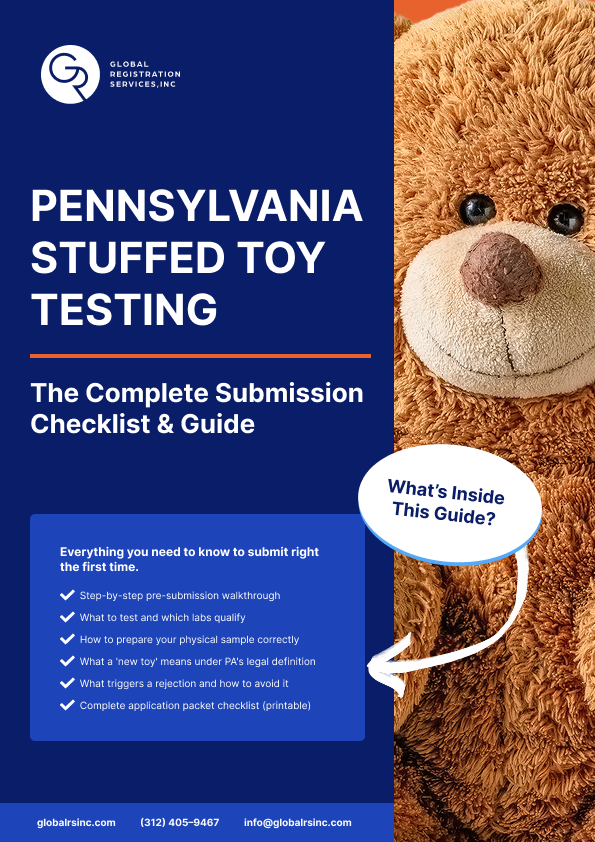
Pennsylvania requires testing of a stuffed toy's outer covering, not just its filling. Coverings are classified by flammability, and Class IV materials aren't accepted. If you're planning new toy submissions, confirm your lab report covers both the filling and the covering, comes from an accepted lab, and that your samples arrive without tags.Want a head start? Our Pennsylvania Stuffed Toy Testing: The Complete Submission Checklist covers what needs to be tested, which labs are accepted, how to prep your samples so they're right the first time, and everything your application packet needs.
Found something? We're here to help!
You don't have to fix everything alone! If your self-audit turns up an open invoice, a lapsed license, or a form you're unsure about, contact our team. We'll help you sort it out before the new year. If you'd rather hand off renewals entirely, our team can take them off your plate if you’re subscribed to one of our Monitored Services.
Retail Compliance for Stuffed Articles: Protect Your Holiday Sales From Supplier License Lapses
How Stuffed Article Compliance Really Works: Inside the Product Regulation Process
Want the latest articles and events delivered to your inbox?

Navigate
Services
Services
Stay in Touch
Sign up for Updates