
Go Back
Industry News and Updates

What Pennsylvania’s New Covering Testing Requirement Means for Your Stuffed Products
Picture this: You've done everything right. Your stuffed plush animals are filled with the correct, tested materials, your lab reports are in order, and your law labels are accurate. You submit your Pennsylvania application, feeling pretty good …. and then you get a rejection notice.
Because Pennsylvania now wants to look at the outside of your product, too.
If you manufacture or import stuffed products for sale in Pennsylvania, there's a new layer of testing requirements you need to know about and if you're not already working with GRS to navigate it, this might be a good time to start.
Pennsylvania's Testing Evolution
Pennsylvania has always had stricter-than-federal stuffed toy regulations. The state's requirements stem from the Stuffed Toy Manufacturing Act, which has been in place since 1961 and is enforced by the Pennsylvania Department of Labor & Industry's Bureau of Occupational and Industrial Safety.
Back in August 2024, Pennsylvania made major waves when it began requiring Flammability and Tolerance Lab Reports to accompany all stuffed toy applications, a significant shift from what manufacturers were previously used to. Now, the state is taking things a step further.
What's New: The Covering Has to Be Tested, Too
Previously, the focus of required lab testing was on what's inside the stuffed product — the filling material. Whether you were using polyester fiber, shredded foam, recycled fill, or something else entirely, the fill was the primary subject of testing.
Pennsylvania now requires that the covering — the outer shell or fabric of the stuffed product — also be tested. This falls under 34 Pa. Code §47.321, which governs fabric requirements for stuffed toys and classifies coverings by their flammability characteristics. Classes I, II, and III are accepted as having no unusual burning characteristics; Class IV coverings are considered dangerously flammable and unsuitable for stuffed toys.
In plain terms: the plush, the fabric, the shell — whatever is on the outside of your product — needs to be evaluated and documented, not just the stuffing inside.
This is a meaningful addition to the compliance checklist. Many manufacturers assumed that if their fill was compliant, they were in the clear. The new requirement makes it explicit that the whole product is under review, inside and out.
Why This Makes Sense (Even Though It’s More Work)
Think about how a stuffed toy actually interacts with a child. They're not touching the polyfill, they're touching the fabric. They're sleeping with it, carrying it around, putting it close to their face. The flammability of the outer covering is a genuine safety consideration, and Pennsylvania's regulators are treating it accordingly.
While the additional requirement may feel like more complexity on your end, the intent is straightforward: ensure the full product meets safety standards.
Every "New" Toy Needs Its Own Registration
One of the more nuanced aspects of Pennsylvania's program is how the state defines a "new" toy and it's a detail that catches more manufacturers off guard than you might expect.
Pennsylvania requires that each new toy be independently tested and registered with their department. That part most manufacturers know. What trips people up is what "new" actually means.
In Pennsylvania's eyes, a toy is considered new if it uses different filling material or is made with a different manufacturing process even if it looks nearly identical to a product you already have registered. So if your company already holds a valid PA Toy URN but you're now producing something that meets either of those criteria, that product needs its own separate registration.
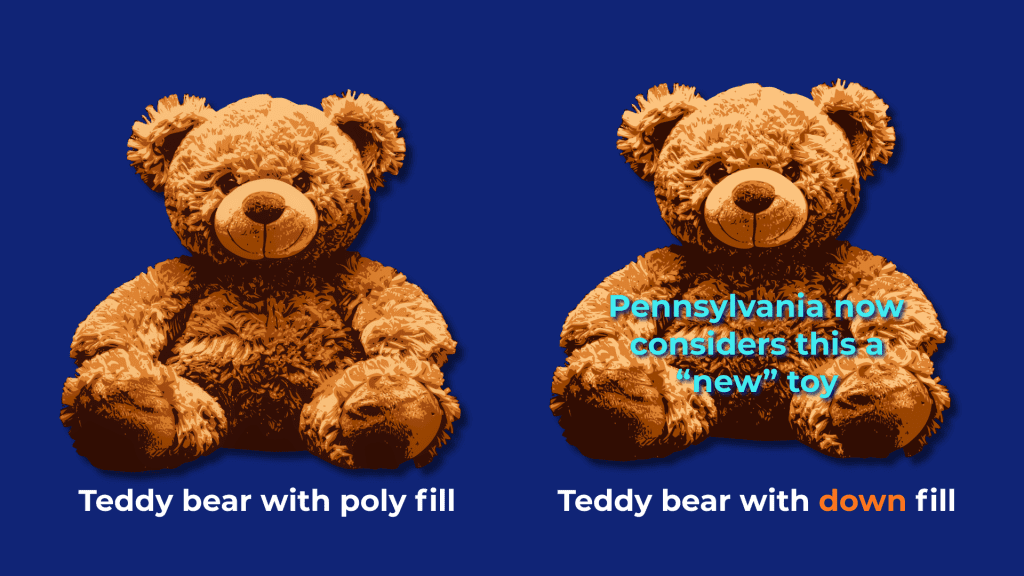
This matters more than it might seem at first glance. A small change in fill blend, a shift in how a component is manufactured, a new supplier with a slightly different process — any of these can technically create a "new toy" under Pennsylvania's definition. Submitting it under an existing URN without a new registration can result in a rejection, or worse, a violation.
When you work with us, we help you identify upfront whether your product qualifies as new under PA's definitions before you invest time and money in a submission that won't hold up.
Not Just Any Lab Will Do
Here's something worth knowing before you schedule your testing: Pennsylvania does not accept lab reports from just any facility.
Your Flammability and Tolerance Lab Report must come from either a CPSC-certified lab or a branch of a U.S.-based lab. A report from an uncertified or non-qualifying facility — even a well-regarded one! — will not be accepted, and your application will be rejected.
No Tags, No Labels, No Exceptions
This is one of the most surprisingly common causes of rejection, so it's worth saying clearly: when you submit a physical toy sample to Pennsylvania, it must arrive with absolutely no tags or labels attached.
That includes law labels, hang tags, and cut tags. If Pennsylvania receives a sample where a tag has been removed and there is visible evidence it was ripped or cut off, they will reject the sample outright.
The state wants to evaluate the toy itself in its clean, untagged state. Any sign of label removal raises an immediate flag. So the sample going to Pennsylvania needs to arrive tag-free, with no evidence that anything was ever attached and taken off.
If You're Testing Through GRS, You're Covered
Not to toot our own horn, but when you handle your stuffed product testing through GRS, your testing is structured to satisfy both Pennsylvania and Ohio requirements in one coordinated process. You don't have to run separate tests, manage two different lab relationships, or figure out on your own how to make your documentation satisfy two distinct state review lenses.
We've built our testing facilitation specifically around the way these states review submissions — including knowing which regulatory sections apply, how reports need to be formatted, and what terminology the states expect to see. The difference between a clean first-time approval and a cycle of rejections usually comes down to the details.
With the new covering/shell testing requirement now in the mix, that expertise matters even more. We know which fabric testing classifications apply to your product type, how to select the right samples, and how to ensure your documentation reflects the full picture — fill and covering — in a way that holds up to Pennsylvania's scrutiny.
A Quick Checklist: What PA Now Requires for New Stuffed Toy Applications
Here's what needs to accompany a new Pennsylvania stuffed toy application:
- Product sample (selected at random from manufacturing)
- Completed application form (current version)
- Notarized Affidavit
- Flammability and Tolerance Lab Report covering both filling material (§47.317, §47.322) and the outer covering/fabric (§47.321)
- Manufacturer attestation that no child, forced, or slave labor was used
- Application fee
If any of these elements are missing or incorrectly formatted, Pennsylvania will reject the application and charge an additional fee for resubmission. There is no grace period remaining, enforcement is active now.
For more detail directly from the state, visit the PA Department of Labor & Industry's Stuffed Toys page and their Bedding and Upholstery / Stuffed Toy FAQs.
Don't Let a Covering Requirement Uncover a Compliance Gap
Regulatory updates have a way of sneaking up on even the most diligent manufacturers. If you're already in the GRS ecosystem, you're in the right hands, and if you're not, this is a great moment to change that!
We're here to make sure your stuffed products are tested correctly, documented properly, and approved efficiently — whether you're navigating Pennsylvania, Ohio, or both.
Ready to get started?Get in touch today and let's make sure your compliance is airtight, inside and out.
Retail Compliance for Stuffed Articles: Protect Your Holiday Sales From Supplier License Lapses
How Stuffed Article Compliance Really Works: Inside the Product Regulation Process
Want the latest articles and events delivered to your inbox?

Navigate
Services
Services
Stay in Touch
Sign up for Updates